

Scroll for five minutes, and you’ll see someone hyping fiber gummies, fiber powders you dump into your coffee, or some “20 grams of fiber in one bar!!” product that costs more than your actual groceries for the week.
Fiber is basically protein’s little sibling now. Same hype cycle, different nutrient.
And honestly? I’m not mad that fiber is finally getting attention. It’s one of the most underrated things you can focus on for your health. I just want to talk about it without turning it into another thing you have to buy your way into. Because you don’t.
Photo by Jannis Brandt on Unsplash
Why fiber actually matters
Fiber does a lot of quiet, unglamorous work.
It keeps things moving (you know what I mean).
It helps you feel fuller longer.
It feeds the good bacteria in your gut.
It helps keep your blood sugar more stable throughout the day instead of spiking and crashing.
It’s not flashy. It’s not going to go viral on its own merit. But it matters, a lot, and most people are not getting nearly enough of it. The daily recommendation is around 25 grams for women and 38 grams for men. The average American gets about 15. So yes, we should be talking about this.
Did you know there are two types of fiber (but you don’t need to stress about them)
You may have heard that there are two kinds of fiber: soluble and insoluble. Here is a quick, no-overthinking-required breakdown.
Soluble fiber dissolves in water and forms a gel-like consistency in your gut. This is the type that helps slow digestion, keeps you feeling full longer, helps lower LDL cholesterol, and plays a big role in stabilizing blood sugar. You find it in oats, beans, apples, citrus, flaxseed, and carrots.
Insoluble fiber does not dissolve. It adds bulk and keeps things moving through your digestive tract, which is what most people mean when they talk about fiber and digestion. You find it in whole grains, nuts, vegetables, and the skins of fruits.
Both are important. Both are doing different but complementary jobs in your body.
Here is the part I want you to actually take away from this: you do not need to think about which type you are eating. You do not need to track soluble versus insoluble grams or strategically rotate your fiber sources. If you are eating a variety of real foods- fruits, vegetables, whole grains, beans- you are naturally getting both without a second thought. The only time the distinction really matters is if you have a specific GI condition and your doctor or dietitian has given you targeted guidance. Otherwise, just eat the food and let your gut do its job.
Here’s the part nobody’s telling you
You do not need a supplement to get your daily requirements.
Let’s talk about what the fiber gummy is actually doing, because it’s not, nothing, but it’s not what the marketing wants you to believe either. Most fiber gummies contain 2 to 4 grams of isolated fiber per serving, usually from a single source, such as inulin or chicory root. That’s it. You are not getting the vitamins, minerals, antioxidants, or water content that come packaged with fiber in real food. You are getting a concentrated dose of one type of fiber, often in a format that your gut can find pretty aggressive if you take more than the suggested amount.
Here is the comparison that matters.
A single cup of black beans has around 15 grams of fiber, costs maybe 50 cents, and also gives you protein, iron, and complex carbs.
A bag of fiber gummies with 60 servings of 4 grams each costs you $20 and gives you fiber and sugar alcohols (these can also wreak havoc if taken in large doses). The math is not complicated: save money, get better nutrition.
Photo by Janek Valdsalu on Unsplash
And this is where it connects to weight loss in a way nobody is really talking about.
We saw this same hype cycle play out with protein. Everyone started adding protein powders, protein bars, protein chips, and protein everything, but a lot of people were not losing weight because they were also adding a significant amount of calories to hit those protein numbers. More protein is great. More calories on top of what you were already eating is not going to help if weight loss is your goal.
Here is the SECRET SAUCE -Fiber is actually different in one really meaningful way. Fiber-rich whole foods tend to be lower in calories relative to how much volume and fullness they give you.
A cup of raspberries is about 65 calories and 8 grams of fiber. You are getting a lot of food, a lot of chewing, and a lot of satiety for very few calories.
On top of that, your body does not fully absorb the calories from fiber the way it does from other carbohydrates.
Some of it passes through without being broken down, which means you are effectively getting fewer net calories than what is on the label. More food, more fullness, fewer calories absorbed. That is a genuinely good deal, and you cannot get it from a gummy.
Real fiber comes from real food, and it is already sitting in your grocery store with no upsell required.
Think about what actually has fiber in it: beans, lentils, berries, oats, vegetables, whole grains, apples, avocado, nuts, seeds. This is not a fancy list. This is just food.
Here is what realistic fiber intake actually looks like across a normal day:
A half cup of oats at breakfast gets you about 4 grams. A banana on the side adds another 3. At lunch, a cup of black beans on a taco or in a bowl brings in around 15 grams on its own. An apple as a snack adds 4 more. A cup of broccoli at dinner is another 5. A slice of whole grain bread is roughly 2 to 3. You are already over 30 grams, and you did not buy a single powder or gummy to get there.
That is the whole point.
How I actually coach clients
This connects directly to P.P.C., my framework of Protein, Produce, Carb. The produce category is not just a “get your vitamins” checkbox. A huge part of what makes produce valuable is the fiber that comes with it. Berries, vegetables, fruit - these are all doing double and triple duty when they show up on your plate.
So if you are already building most of your meals around a protein, a produce, and a carb, you are probably getting more fiber than you think without even trying to “fiber-max” anything.
My yogurt bowl at lunch is a perfect example. Oikos Greek yogurt, cottage cheese, mixed berries, and Catalina Crunch on top. That bowl has protein from the dairy, fiber from the berries and the cereal, and it takes five minutes to put together. No fiber supplement needed.
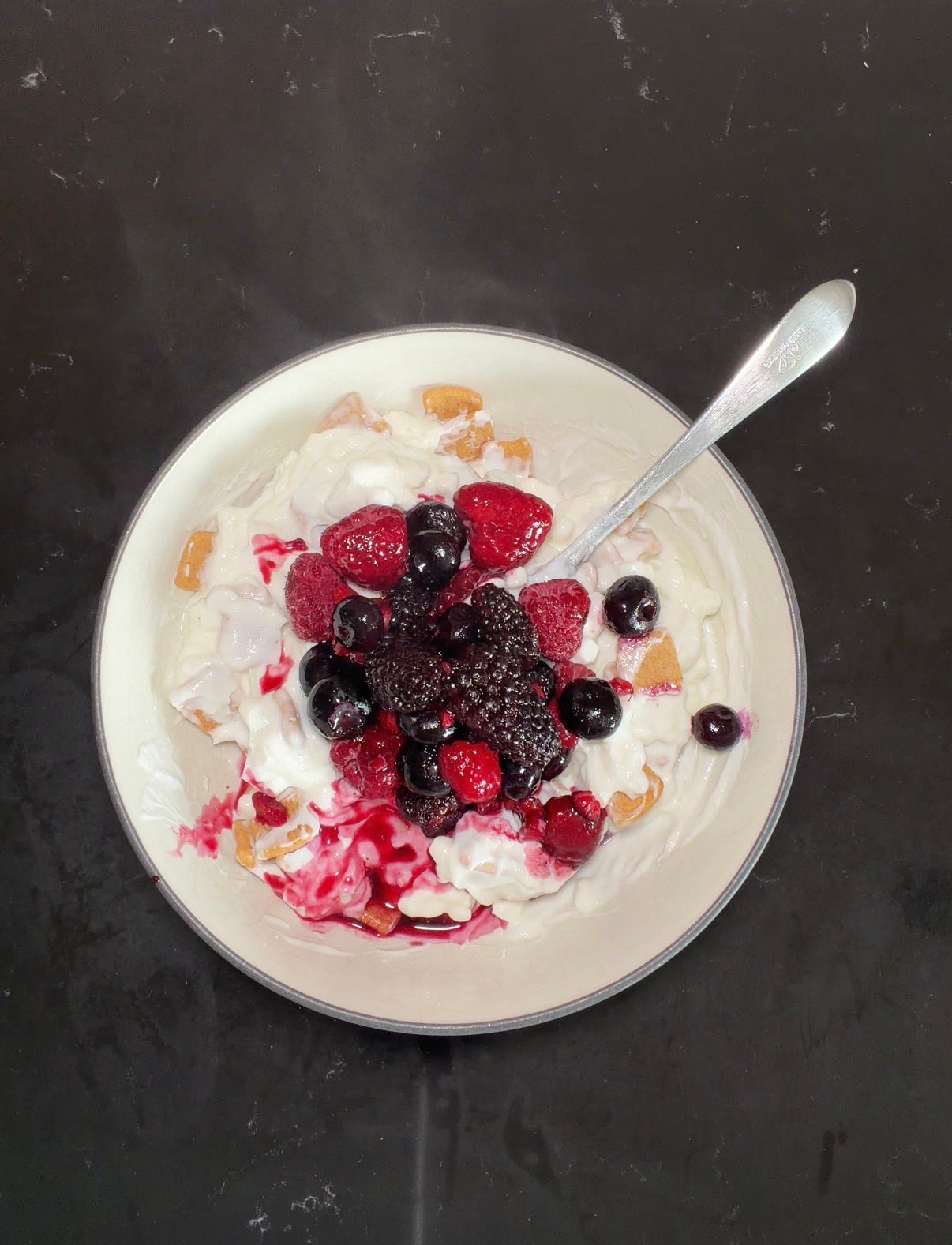
Photo - by me 💁🏼♀️
Tacos with corn tortillas, ground beef, peppers, and onions? Fiber from the tortillas and the vegetables. Grilled chicken over a salad with avocado? Fiber from the greens and the avocado. You are hitting fiber goals with meals that are just normal meals.
What to actually do if you want more fiber
Start with one swap or one addition, not a complete overhaul.
If you are eating white rice, try swapping half of it for brown rice or adding a handful of beans to the same bowl. If your breakfast is mostly protein with no produce, throw some berries on top or blend a handful of spinach into a smoothie. If you are snacking on something crunchy, an apple with peanut butter or a small handful of almonds gets you fiber plus staying power.
The goal is progress, not perfection. Adding 5 to 10 grams of fiber to your day by making one or two simple swaps is genuinely going to move the needle. You do not need to reach 38 grams overnight.
One thing to keep in mind: if you are increasing your fiber intake significantly, do it gradually and drink more water. Adding a lot of fiber too fast without enough fluid is a recipe for bloating and discomfort, and then you will blame fiber instead of the pace at which you added it. Go slow. Drink water. Simple.
A note for anyone on GLP-1 medications
If you are taking a GLP-1 medication like Ozempic, Wegovy, or Tirzepatides like Zepbound or Mounjaro, this section is specifically for you.
GLP-1s slow down how quickly food moves through your digestive system, which is actually part of how they help you feel full longer and eat less. That sounds great in theory, and it can be. But slower digestion plus low fiber intake is a combination that causes real problems, like significant constipation, bloating, and general GI misery that makes an already appetite-suppressed situation even harder to manage.
Fiber keeps things moving. When your gut motility is already slowed down by medication, getting adequate fiber becomes even more important than it is for someone not on a GLP-1. The goal is not to overload your system, especially since you are likely eating much smaller amounts overall. It is to be intentional about including fiber-rich foods in whatever you are eating, even if that is not a lot.
A few things to keep in mind if you are on a GLP-1. First, smaller meals mean you have to make those meals count. If you are only eating one or two real meals a day because your appetite is that suppressed, those meals need to have fiber in them. A handful of berries, some vegetables, a serving of beans- these things matter more when your food volume is lower. Second, hydration matters even more. Fiber needs water to do its job, and dehydration on top of slowed motility is a recipe for discomfort. Third, go slowly with fiber increases. Your gut is already working differently on these medications, so flooding it with fiber all at once is going to be uncomfortable. Add it gradually. You may not be able to reach the 25-38g/day goal, and guess what - That’s OK!
The goal on a GLP-1 is not to white-knuckle your way through nausea and restriction and just hope for the best. It is to give your body what it needs to function well while the medication does its job. Fiber is a non-negotiable part of that.
Fiber deserves the attention it is getting. It just does not need the hype machine attached to it.
Eat real food with some consistency, build your meals around produce most of the time, and you are probably doing more for your gut than any powder promises to do. Save your money. Buy the beans.
If building balanced meals still feels overwhelming, or you are not sure how to make this work in your actual life, that is exactly what I help clients figure out. No gimmicks, no supplement aisle required.
The bottom line
Eat real food with some consistency, and you’re probably doing more for your gut than any powder or gummy promises to do.
If figuring out how to actually build balanced meals feels overwhelming, that's exactly what I help clients with. No gimmicks, no supplement aisle required. You can learn more about working with me here.
And… if this helped you rethink fiber (or you know someone who needs to stop buying the next fiber supplement), send this their way.
Thank you for reading and your support!
Stay Empowered!
Laura